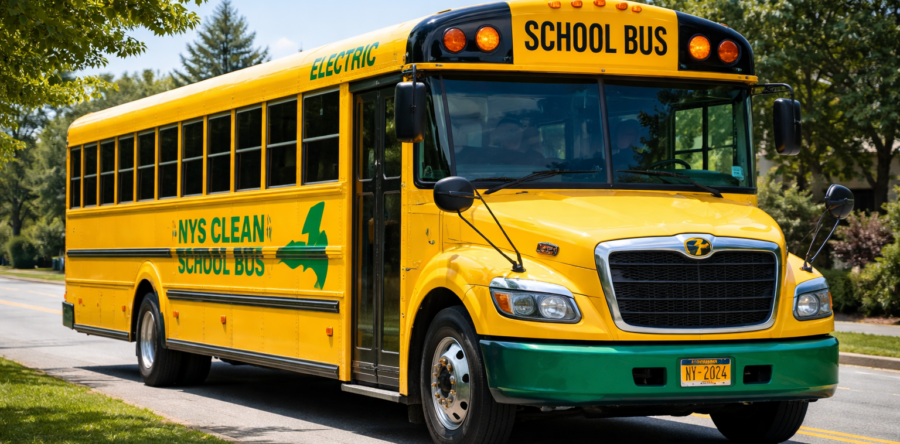
Electric School Buses: When a Mandate is Not Ready
By Dr. Rick Timbs (and a little help from Chat GPT)
Executive Director, Statewide School Finance Consortium
Let me be clear at the outset: this is not an argument against clean air, environmental responsibility, or innovation. School districts support those goals. I support those goals.
What I am increasingly concerned about is the growing gap between policy ambition and operational reality when it comes to electric school buses in New York State.
Over the last several years, school districts have been told that a full transition to zero-emission buses is not optional. Diesel purchases must stop by 2027, and full electrification is required by 2035. That may sound like a long runway in Albany. On the ground, it’s anything but.
Recent reporting by the New York Post has added real-world data to concerns school districts have been raising quietly for years — about cost, reliability, infrastructure, and basic feasibility. Exclusive | Lee Zeldin hits the brakes on $2.3B for Biden's green school buses -- threatening Hochul's EV mandate | New York Post
The Cost Gap Is No Longer Debatable
One of the first questions districts must ask is simple: what is the actual cost difference between what we buy today and what we are being told to buy tomorrow?
According to the New York Post, electric school buses funded through the federal Clean School Bus Program are averaging more than $318,000 per vehicle, with some New York City buses approaching $395,000 each. By comparison, many districts currently purchase diesel buses in the $90,000 to $120,000 range, depending on configuration.
However, throughout much of Update New York the issues are framed similarly, but the costs are more problematic. Upstate New York has more factors to consider. Update New York has mountains, forests, significant snow belts, lakes of all sizes and configurations, big and small rivers, long winding roads, places with no or poor cell service, high winds, long cold winters and isolated populations with multiple hamlets, villages, and clusters of communities far from each other.
Driving through and maintaining a reliable transportation service to children with these considerations is a complicated and expensive task to begin with. Although some Update New York school districts have above average property and income wealth that could, in part, suggest that fiscal capacity is not an extensive issue, they are small in number. By far the vast majority of Update school districts truly lack the property values, resident income capacities or political will to support the cost consideration for the mandated transition to Zero-Emission buses. With current escalating costs, the presence of an artificial tax cap, the current economic conditions can be characterized as an “affordability” issue as school district budgets experience increasingly strained expenses, from cost escalations and competition for teachers and support staff, health insurance, educationally related expenses, and other pressing fiscal issues.
Upstate school districts need all sizes of buses and many of them big buses that cost at least $170,000 each if they are diesel. They last mostly between 5 to 10 years not depending on the miles traveled but also based on wear and tear from the climate and topography. By comparison, a single large Zero-Emission Bus costs around $400,000. Every study I’ve seen suggests that battery life is 7 years and they will not function nearly as well or as long in the climate and topography of Upstate New York as their diesel counterparts.
Those differences totally reshape every bus replacement plan in Upstate New York. The school districts I have conferred with have no solid financial plan, idea, or enthusiasm to hop into a state mandate that is clearly not well thought out, funded or supported and in the view of some, would threaten support and continuity of their core mission to provide a robust educational program for the children of their school district.
Fiscal Scenario #1: A Typical Replacement Cycle
Consider a mid-sized district that replaces two buses per year, paying cash based on the New York Post proposition:
- Diesel model: 2 buses × $110,000 = $220,000 per year
- Electric model: 2 buses × $325,000 = $650,000 per year
In the New York Post proposition that is an additional $430,000 annually, before accounting for chargers, electrical upgrades, or training.
Consider a large-sized (square miles and topography) district that replaces two buses per year, paying cash based on the Upstate New York Parameters:
- Diesel model: 2 buses × $170,000 = $340,000 per year
- Electric model: 2 buses × $400,000 = $800,000 per year
In Upstate New York proposition that is an additional $460,000 annually, before accounting for chargers, electrical upgrades, or training.
I’ve got to believe that if school districts that currently buy buses in cash throughout New York State attempt to maintain a cash purchase regime into the future, it will draw down on cash reserves or capital reserves and exhaust them or create an added expense to the general fund budget that would require a significant reallocation of expenses and district priorities over time.
For districts using Bond Anticipation Notes or Serial Bonds, the impact compounds. Hypothetical Examples:
Higher principal means higher interest costs, longer amortization periods, and greater pressure on debt limits that voters must approve.
For instance, amortizing under current conditions a $170,000 bus over five years would obviously provide savings over the amortization of a $400,000 bus for eight years. Undoubtedly, no amount of additional funding proposed by the Governor would be enough to assuage school districts from the fiscal realities of the Zero-Emission bus cost issues.
Additionally, there will be a significant difference in costs to New York State government in the form of Transportation Aid as well. I have not seen any estimates on the additional amount of Transportation Aid that would need to be provided to school districts for the movement from diesel to electric buses. I have got to believe, taken together, it will be considerable. I am unsure if the additional Transportation Aid costs associated with this mandated transition have been factored into current estimates of future state budgets not only for school districts but also for the investment needed in power infrastructure by New York State.
Infrastructure: The Quiet Budget Buster
The bus is only part of the cost. Electric fleets require charging stations, upgraded electrical service, potential transformer replacements, and in many cases, significant modifications to transportation facilities. Older bus garages were not designed for battery storage, high-voltage systems, or modern fire suppression standards.
The New York Post cites estimates placing the total cost of replacing New York’s roughly 45,000 diesel buses at more than $11 billion — and that figure does not include infrastructure or facility upgrades. I am thinking closer to $15 billion for just the buses (spare buses needed for special routes (special needs students transportation concerns and the need to make longer routes shorter), athletics and DOT inspection purposes are an additional thought.)
Fiscal Scenario #2: Facility Conversion
The New York Post provides a conservative example for a district converting its transportation facility:
- Electrical service upgrade: $750,000
- Chargers (10–15 buses): $500,000–$900,000
- Fire safety and code compliance: $250,000.
- Design, contingencies, escalation: $300,000.
Total potential capital cost: $1.8–$2.2 million
That is a separate capital project — with its own debt, voter approval, and aid assumptions.
While there is no “aid ceiling “ on aid eligible capital project costs for transportation facilities, there are complex matters with a full-on electrical upgrade to a facility.
Part of the problem is access to electrical power, hampered on occasion, by distance, terrain, subsoil, or overhead transmission line issues. Add to this the inconvenience of the timing of the transformation, the length of time of the work, hindered by the length of time to secure the necessary building materials. Further, there can be other obstacles to efficiency and costs- namely the availability of a competent workforce, reasonable bids, and the phasing of the work. This may be exacerbated by the possible reality that all of this type of work would need to be started, financed and completed in a relatively brief period of time, and more or less, at the same time, throughout New York State. Aside from the ‘normal” capital project problems created from “unknowns” throughout every project, issues related to the construction itself provide and additional threat.
Reliability Isn’t a Talking Point — It’s a Safety Issue
Perhaps the most troubling aspect of recent reporting involves performance in winter conditions.
The New York Post detailed complaints from Erie County parents whose children were reportedly cold on electric buses that struggled to maintain heat, and instances where buses broke down mid-route, leaving students waiting in freezing temperatures. These are not edge cases. New York is a cold-weather state. Routes are long, rural, and often involve hills, poor road conditions, and limited access to backup vehicles. If a bus fails, the question isn’t ideology — it’s how do we get kids to school and home safely?
Manufacturing and Delivery Risk
Another issue that deserves more attention is supply. Has anyone asked for a guarantee that the industry can deliver 45,000 buses to school districts by 2035? The Post reports that dozens of school districts nationwide are still waiting for buses that were funded years ago. The EPA’s own inspector general found vulnerabilities to waste and abuse, including payments made before buses were delivered — or, in some cases, before manufacturers proved they could deliver at all.
New York school districts are being asked to bet their transportation systems on a manufacturing pipeline that has not yet demonstrated the capacity to meet demand to scale.
Questions That Still Don’t Have Answers
In earlier columns, I laid out a lengthy list of questions school districts need answered. They still apply — and in light of new data, they matter even more:
- Will New York State have the financial resources in Building Aid to cover transportation facility conversions?
- Will New York State have the financial resources in Transportation Aid cover the purchase of Zero-emission buses with greater cost and amortization schedules?
- Will the electric grid support mass overnight charging statewide?
- Will training for mechanics, drivers, and first responders be affordably funded by school districts?
- Will smaller and rural districts receive flexibility or waivers for as long as they are needed?
- What do we do with a mandate the requires voter approval to buy Zero-Emission buses and a mandate requiring us to buy Zero-Emission buses simultaneously?
- Will grants today cause a financial jolt tomorrow?
To date, many of these questions remain unanswered or vaguely addressed.
A Mandate Without Margin for Error
Even supporters of electrification should acknowledge a basic truth: there is no margin for error in student transportation. Encourage those ready and able to make the transition to move accordingly.
As Assemblyman Robert Smullen told the New York Post, districts are being forced to divert money from classrooms into transportation systems that add nothing directly to instruction — while assuming risks they did not create.
Good policy is phased and adapts - because hopefully, state government listens and reevaluates previous choices. The mandate to transition to Zero-Emission buses is clearly aspirational, and currently unrealistic. Right now, many school districts are saying the same thing:
- We are planning but there is no discernible political or fiscal path for almost all of us. We are wasting hard earned political support and political capital from our school district residents and we just don’t have the money now or in the near future.
- Waivers are not the answer. Using 4 years of waivers, if the mandate remains, would offer school districts less time (4 years only compared to 8 years without waivers) to transition their fleets to Zero-Emission buses.
- We are not ready — and neither is the system.
- But unambiguously, the prudent thing to do is to move this mandate back a decade immediately.
Coupled with topographic and climate issues, look at these data sets and think practicality:
The disappointment about this issue is palatable; the state has not only failed to realistically recognize the dilemma here, but they have not provided appropriate relief either. The remedy is obvious.
We are watching and we are nervous....
Rick